
Five habitats, one identifier#
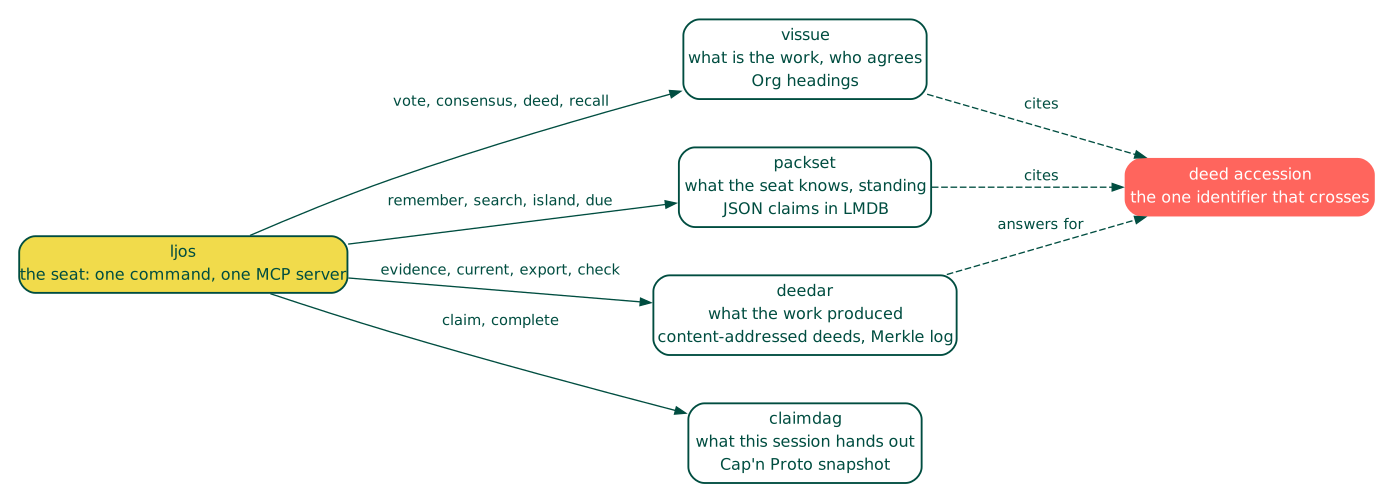
Each habitat answers one question and is the authority for it. Cards
are read-only. A deed accession is the one identifier that crosses the
writable habitats: the tracker cites it on a node, the pack cites it
in a claim, the deed store answers for it. No habitat opens another’s
format. The seat composes them by passing accessions on pipes, and
stays thin: its only state of its own is the mapping from tracker ids
to claim-graph nodes. Argv law sits beside them. It is not a sixth
store. ljos policy prints the line; ljos-policyd is the TCB when
it is on PATH or POLICYD_BIN.
The contracts#
Citation is not a merge. Citing a deed names it; the bytes stay in the deed store.
Completing a session node does not close a ticket. The claim graph is session state; the tracker decides when work is done.
Cards are read-only. The seat writes to the pack; a person writes the cards.
The pack is written only by
remember,prefer,trust,learn,graded,forgetand an imported handover. Nothing is extracted from a transcript.A tool that fails is a habitat refusing or down, and says which. It is never an empty answer.
Memory that grows, is reviewed, decays, and is retracted#
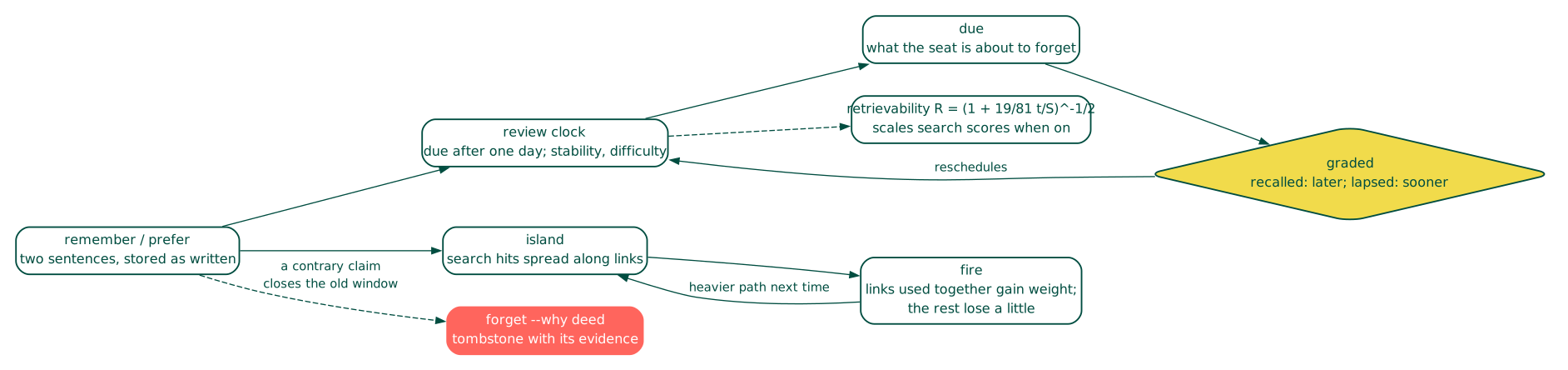
A claim enters the pack because the seat decided it was worth keeping, and
enters a review clock at the same moment. The clock is the spaced-repetition
model the Free Spaced Repetition Scheduler (FSRS) fits to review data (doi:10.1145/3534678.3539081): a stability in
days, a difficulty, and a due date; recalled grows stability by how overdue
the claim was, lapsed halves it. due is what the seat is about to forget.
When the pack’s decay slot is on, the same retrievability
R = (1 + 19/81 * t/S)^(-1/2) scales a search score, so an unreviewed
claim sinks without vanishing. The power-law form is the one Wixted and
Ebbesen measured (doi:10.1111/j.1467-9280.1991.tb00175.x); the spacing
effect it schedules for is reviewed by Cepeda et al.
(doi:10.1037/0033-2909.132.3.354). A claim shown wrong is retracted with
the deed that showed it, and a contrary claim closes the old one’s window.
On a longitudinal corpus where one claim per topic is kept recalled and
three paraphrases written later are not, retrievability ranks the kept
claim first 0.947 of the time; lexical scoring lands at chance and a
recency half-life at 0.270 (the packset site carries the table).
Islands#
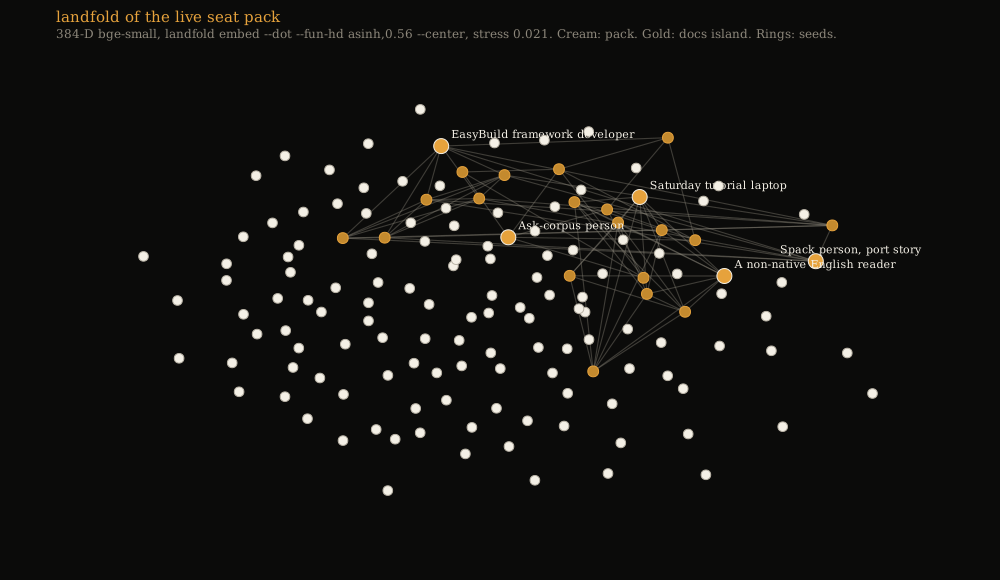
A task does not touch everything a seat knows. The pack links each claim to
the claims it shares names with, pruned so a neighbourhood spreads over the
directions a claim is about. Those links form natural clusters, and
ljos island finds the one a task activates: the top search hits are the
seeds, activation spreads two hops along the links with half lost per hop
and divided by fan-out, and the cluster comes back strongest first. That is
spreading activation over a semantic network (Collins and Loftus,
doi:10.1037/0033-295X.82.6.407), not a persona: a persona is a view that
colours everything, an island is what this piece of work involves. The
pack can also list its islands outright, by label propagation over the link
graph (doi:10.1103/PhysRevE.76.036106).
Use shapes the graph. Every link carries a weight, 0.5 until something
fires over it. When the seat goes on to use an island, ljos island --fire
says so, and the strongest eight fire together: each pair’s weight moves a
tenth of the way to one, a pair with no link gains one, and every other link
of a fired claim loses two percent. Hebb’s rule with Oja’s forgetting term
(doi:10.1007/BF00275687), so weights stay bounded and paths a seat never
walks fade without being deleted. Activation spreads in proportion to
weight, so the next cue like this one walks a heavier path. The weights are
on the atom beside the links and travel in a handover.
The island was measured as a ranking on LongMemEval and lost: sessions linked to their five nearest by dense cosine, the fused top ten seeding the same spreading activation the writer runs, hit@1 0.377 against the fused panel’s 0.889 over 470 questions, recall@10 unchanged at 0.981. Activation flows to the well-connected, which is what a hub is and not what a question asks for. The negative fixes the island’s place: what the seat prints beside the hits at a sitting, for orientation, and what fires together after use; never the order the hits come in.
Time as data#
Every record in the seat is dated: an atom carries the writer’s clock and,
when it was retired, the window it was live in; a deed carries the time it
was produced; the tracker’s logbook carries the time of each note, state
change and claim. The seat hands that to the reader as data rather than as
stamps to subtract. Every recalled memory, in the hook, a brief, ljos
search, the island in ljos sitting, carries its age in words (today,
3 weeks ago), and the hook’s lessons run oldest to newest behind the
preferences, so a later lesson reads as a revision of an earlier one. ljos
timeline ISSUE merges the three stores into one dated list with the gap
between consecutive lines, and ljos search --as-of TIME asks the pack as
it stood at an earlier time.
The design came out of measurement. On a public long-conversation benchmark the seat’s retrieval finds the right session at the top for nine questions in ten, and the answers a small reader gives over those sessions fall furthest on the questions about time: handed raw dates it did the arithmetic itself and got a third of them. A reader is a poor calendar; a store that already knows every date is a good one, so the store does the arithmetic and the reader reads the order.
The field, and where the seat stands in it#
Agent memory systems in the literature and on the market do one of a few jobs, and the seat’s design can be read against each.
Mem0 (doi:10.48550/arXiv.2504.19413) reads a conversation with a model, extracts facts, and has the model decide for each whether to add, update, delete or leave the store; a graph variant adds entity nodes. Zep (doi:10.48550/arXiv.2501.13956) builds a temporal knowledge graph: a model extracts entities and relations, each edge carries the time it became true and the time it stopped being true beside the time it was written, and retrieval is lexical, dense and graph search fused and reranked. MemGPT (doi:10.48550/arXiv.2310.08560), now Letta, keeps a small core memory in the model’s context that the model edits with tools, a recall store of the conversation and an archival vector store, and its sleep-time compute (doi:10.48550/arXiv.2504.13171) reorganises memory between turns. A-MEM (doi:10.48550/arXiv.2502.12110) keeps notes with model-written keywords and links and rewrites older notes when a new one arrives. HippoRAG (doi:10.48550/arXiv.2405.14831, doi:10.48550/arXiv.2502.14802) extracts a knowledge graph and retrieves by personalised PageRank from the entities a question names. MemoryBank (doi:10.48550/arXiv.2305.10250) forgets on an Ebbinghaus curve refreshed by recall; Generative Agents (doi:10.48550/arXiv.2304.03442) rank by recency, importance and relevance and reflect. All of them put a model in the write path.
The seat does not. What is remembered is what was said with Remember or
Prefer, stored as written, so a transcript never becomes a belief by
being read; that is the privacy-of-write, and it is the one design choice
here that the others do not make. Forgetting is by review rather than by
age: retrievability from the clock of what was recalled and when, the
same schedule spaced repetition runs, where MemoryBank ages by time and
Generative Agents by recency. Time is data, as in Zep: a claim carries the
time it was written and the window it was live in, a later claim with the
same head closes the earlier one, and the pack can be asked as of any
time. Retrieval is a panel of scorers fused, as Zep fuses, and every hit
says how many scorers named it. The link graph is Hebbian: use strengthens
a link and disuse fades it, and the cluster a task activates is read
beside the hits for orientation, not in their place, because measured as
a ranking it lost. Above the pack the seat has what a memory alone does
not: ballots settled under trust rows that learn from outcomes, deeds
that stand for what the work produced, a claim graph for who holds what,
and a signed handover another seat can check.
What the others have that the seat does not: extraction. A model reading
a transcript finds facts nobody said Remember to, and on a benchmark of
chat logs that coverage is most of the score. The pack has a proposals
path for that, gated so a proposal becomes a claim only on an explicit
accept, and it runs on a model the seat does not ship. Measured on the
public benchmarks with one small reader, the seat’s retrieval finds the
right session first nine times in ten on LongMemEval
(doi:10.48550/arXiv.2410.10813), answers within a few points of the
labelled-session ceiling where retrieval decides, and on MemoryAgentBench
(doi:10.48550/arXiv.2507.05257) the fused panel with that small reader
answers 0.675 of the accurate-retrieval questions against the published
0.605 for BM25 and 0.651 for HippoRAG-v2 with a hosted reader, and its
replacement rule takes the conflict-resolution split to 0.480 against
their 0.155 to 0.295; the memory products sit behind the retrievers on
both, as that benchmark’s authors found. The packset site carries every table and the
reproduction package regenerates them.
Agreement that learns#
A tally counts, and a count is right only when every voter is worth the
same. The seat settles a vote with DeGroot’s model
(doi:10.1080/01621459.1974.10480137), or Friedkin and Johnsen’s anchored
version (doi:10.1080/0022250X.1990.9990069), over trust rows. The rows are
pack atoms, so they are memory: dated, supersedable, exportable. learn
moves them by what turned out right: each voter’s record of outcomes that
agreed with its ballot and outcomes that did not, this one added, gives
its accuracy, and the rows are the log odds of that, so a voter is weighed
by what it got right rather than by how many times it was punished. The
multiplicative update of Hedge (doi:10.1006/jcss.1997.1504) is kept as
--rule hedge. On voters of known accuracy through the seat’s own settle
(the consensus crate’s synthetic voters, nine voters, four hundred
questions, twenty seeds) the record answers 0.929 of the questions, batch
calibration 0.934, the true weights 0.939, Hedge 0.831 and Hedge with a
fixed share of recovery 0.877; a count answers 0.820. A person can also
set a row and cite the deed behind it. When nobody names an outcome, calibrate
estimates each voter’s accuracy from the project’s history (Dawid and
Skene, doi:10.2307/2346806) and writes the rows as the log odds of that
accuracy, the weight under which a weighted majority of independent
voters is the maximum-likelihood decision (Nitzan and Paroush,
doi:10.2307/2526438): nine right in ten outweighs six in ten by five to
one, and chance earns the floor.
A panel of subagents that each read the work and vote is the seat’s form
of the parallel agents the products run (self-consistency,
doi:10.48550/arXiv.2203.11171; multi-agent debate,
doi:10.48550/arXiv.2305.14325; mixture of agents,
doi:10.48550/arXiv.2406.04692; the commercial heavy modes). Two things
differ. The personas are atoms in the pack, with an anchor the settle
honours (Friedkin and Johnsen; a captain that decides a split is a persona
at anchor zero), and the weights are memory that moves with outcomes and
history, scoped to the topics they were earned on. The run_a_panel
prompt orders it: one subagent per persona, one ballot each as itself,
then the settle, then learn when the world answers. Chen et al.
(doi:10.48550/arXiv.2403.02419) show why a count does not improve with
more voices on hard items; a weighted settle is the alternative this seat
takes.
Handover that can be checked#

A handover is a BagIt bag with the tracker slice, the pack’s atoms, and the deeds both cite, each deed with its inclusion receipt against the log head, the manifest signed when the sender has a key. The receiver checks three things in order, each unanswered by the one before: the bag arrived as written, the deeds were in the sender’s log before the handover, and a key the receiver accepts signed it. Only then are the atoms imported, trust rows included. Learning travels with its evidence.
Model and runner agnostic, human readable#
Nothing in the seat calls a model. The stores are files a person can read: Org headings, one JSON object a line, a content-addressed directory, a Cap’n Proto snapshot. Any agent that can run a command or call a Model Context Protocol tool can work the seat, and a person can do the same from a shell or an editor. A read-only viewer over the habitats is the open work.
The agent is told how, in one text. The protocol ljos protocol prints is
the same text ljos onboard installs as a skill and the server serves at
ljos://protocol: which store answers which question, the order of verbs
in a sitting, and the refusals. An agent that misuses the seat has, in
every case seen so far, not been handed that text: it asked the pack for
a deed, claimed with a hex id, or read a failure as an empty answer. The
tool descriptions open with when to call each one for the same reason.